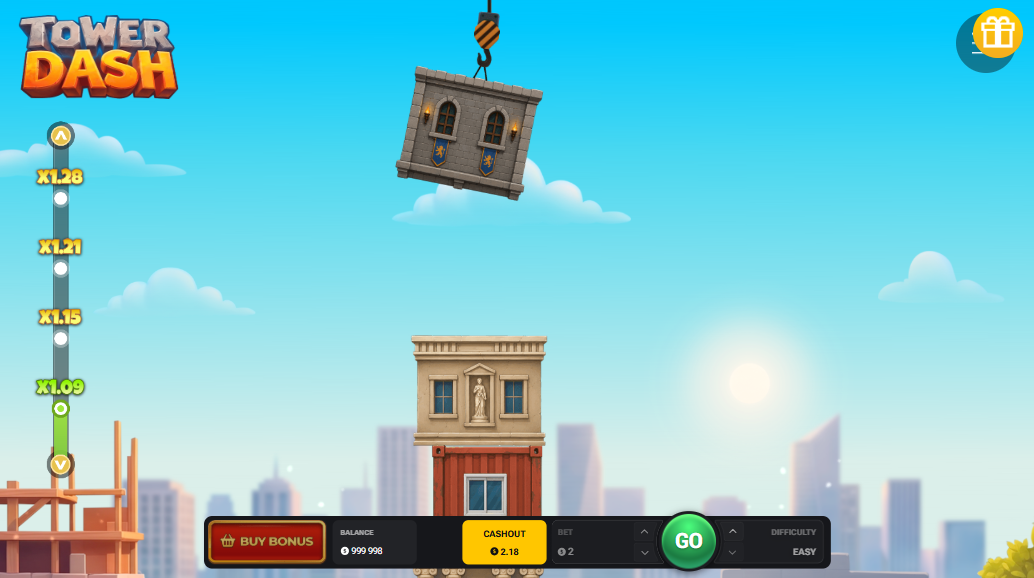
Your finger touches the screen and the first block of Tower Dash drops away from the crane hook. It settles square on the ground, and the multiplier beside it ticks upward for the first time.
That small moment is the whole game in miniature. Tower Dash is a short-round instant game from the studio InOut Games, and each round is one tower built a single block at a time. You set a stake, release blocks one after another, and decide whether to push on or pocket the current value.
The setting is a sunny building site. Cranes lean over everything, stacked blocks crowd the front of the frame and a city skyline fills the horizon, all painted in a bright, cheerful palette that stays upbeat even with real money on the line.
What follows tracks one tower from its base to its end: the stake, the swing, the landing, the moment to stop and the moment it all comes down. Then come the two special blocks, the published numbers, how fairness works, the free version, and a few things to weigh ahead of any paid session.
Nothing here hides the hard parts. A tower can fall on the very first drop.
Setting the stake in Tower Dash
Every round opens before any block moves. The stake comes first, and it stays fixed until the tower either banks or falls.
| Step | Detail |
|---|---|
| Pick the stake | Choose the amount for this one tower. It is at risk from the first block until you cash out. |
| Open the rules screen | Each casino's build comes with its own game rules, which give the stake range, any difficulty settings and the release date. Read the figures there, since builds can vary. |
| Check the mode | Make sure you know whether this is the free demo, funded by virtual chips, or a paid round. |
| Start the round | Confirm the amount and the first block swings into view. |
| Size it against the session | A stake that is small next to your budget leaves room for several towers rather than one. |
A short look at the rules screen is worth the few seconds it takes. Nowhere else shows the precise limits of the Tower Dash build you have open, or the RTP it is set to.
Many players also settle the overall session budget at this stage. Fixing the total once, before the first tower, removes the urge to raise it later in the heat of a run.
The crane and the swing
Once the round starts, a crane arm carries a block into view. It does not hang still. It rocks left and right on its cable, passing back and forth over the stack.
Your part is a single tap. A touch of the screen, or a mouse click on desktop, frees the block and drops it. There is no second control to steer it once it has left the hook.
It is easy to feel that the tap is a test of reflexes. It is not. The tap simply tells the game to release the next block; how that block lands is settled by the game's certified random number generator, as is every other result. Holding out for some ideal spot in the arc, tapping quickly or slowly, or spending hours in the demo does not shift the odds either way.
That is worth holding on to, because the visuals are so convincing. The swaying load and the growing stack invite the idea of aiming. Enjoy the rhythm of it, and keep your attention on the choice that really belongs to you in Tower Dash: one more block, or stop.
Between drops, the crane swings back with the next load and the cycle repeats.
A clean landing
A good drop is the moment Tower Dash is built around. When a block comes to rest squarely on top of its neighbour below, several things happen together.
- The tower grows by one level.
- The multiplier rises, and so does the amount the tower would pay if you banked now.
- You can now cash out, an option open between blocks.
- The crane returns with the next load, already swaying.
- Your stake stays in play. The higher figure only becomes yours once you cash out.
- Each new level adds reward and exposure at once: the tower is worth more, and so is what a single miss would take.
One tidy landing guarantees nothing for the following drop. Each drop is resolved on its own, and a neat streak of blocks says nothing about whichever one comes next.
New players sometimes read a smooth sequence as a sign that the tower is safe. It never is, at any height. The calm after a good landing is better spent checking the current multiplier against what you hoped to take from this round.
Deciding when to stop
This is where the one genuine choice of Tower Dash lives. In the gap after each landing, you may cash out. Do so and the round closes, paying the stake times the current figure. Leave it and another block arrives, with the multiplier ready to rise or the tower ready to come down.
An example shows the trade more plainly than any rule. Take it purely as an illustration, not as a statement about where any multiplier appears. Say you stake ₱250 and cash out when the multiplier reads x2.25: the return is ₱560. Now suppose you leave that same ₱250 in play and the tower falls. The stake is gone.
Same tower, same height. The difference is one decision.
Since nobody can know what the next block will do, a cash-out point is best chosen in advance. Some players pick a modest target and stick to it; others accept that taller towers are rarer and budget for long stretches without one. Either is a matter of taste, not a method that tilts the result.
A common issue is drift. A modest target creeps higher after a good start, then even higher, causing the plan to fall apart step by step. Hasty decisions made while the crane is mid-swing always lead to the same outcome.
Pursuing a towering multiplier to recover an earlier loss is the most frequent type of this mistake, and it typically makes the loss even greater.
When the tower collapses
Eventually, a block will miss. Rounds lost due to a poor drop always happen in the same sequence.
- The released block reaches the stack but fails to catch the edge of the level below.
- The tower loses its balance and falls, taking every level down with it.
- Play stops immediately and cashing out is no longer an option.
- The stake for that tower is lost, regardless of the multiplier the stack had reached.
- From there, you can set a new stake and start a fresh tower, or step back.
A fall isn’t a punishment for poor aim, nor a sign that a better tower is on the way. Each round starts anew and remembers nothing, so prior towers, whether tall or short, offer no insights into the next.
The sensible habit here is to take a pause. Before engaging in a new round, check how much of your session budget remains, and whether the loss limit you set at the beginning has been reached. If it has, that’s the signal to stop for the day instead of raising the stake to recover.
Encountering a TNT crate
Some of what the crane brings in isn’t a standard block at all. TNT crates also appear, and these are rigged.
Land on one, and the game is over. It functions like a missed landing: the tower collapses and that stake is forfeited. No matter how tall the stack had grown or how appealing the multiplier seemed, a TNT crate shuts everything down immediately.
There’s no strategy around this, and no set rate for how often these crates show up. They belong to the random outcome of the round, just like landings do. Going a long time without encountering one doesn’t mean one is overdue, and running into one doesn’t make the next tower any safer.
What the crates do influence is how a wise player considers height. Every additional block in Tower Dash can lead to a clean landing, a messy one, or a rigged crate, and the multiplier at any moment reflects the money still at stake. Hence, the weight of your decision to bank.
The bright skyline rests atop a game with real risks. A tower is only valuable for what you bank from it.
Saved by a Wild block
The second special block works in the opposite manner. Wild blocks can save a sloppy drop, allowing the tower to continue rising. Here’s how a Wild block compares to the other possible outcomes of a drop.
| Sitwasyon | Resulta |
|---|---|
| Isang ordinaryong block ay dumapo nang maayos | Ang tower ay lumalaki ng isang level at ang multiplier ay tumataas. |
| Isang ordinaryong block ay hindi umabot sa dulo | Ang stack ay bumagsak, tumigil ang laro, at ang taya ay nawala. |
| Isang Wild block ay nakasalubong ang masalimuot na drop | Ang drop ay maaaring mailigtas, at ang tower ay magpapatuloy sa pagtaas. |
| Isang TNT crate ang natamaan | Agad na humihinto ang laro; ang stake ay nawala. |
| Nag-press ka ng cash out sa pagitan ng mga blocks | Humihinto ang laro at nagbabayad sa taya batay sa kung anong multiplier ang lumalabas. |
Seeing a Wild block is good news, but it’s not a shield. A messy landing might be salvaged; a TNT crate still ends everything, and the chances on later blocks remain the same.
Tulad ng natitirang bahagi ng round, ang timing ng isang Wild block ay nakasalalay sa random number generator. Walang numero ang inilalabas kung gaano kadalas sila dumating, kaya ang paghihintay para sa isa bago mag-cash out ay walang saysay.
InOut Games at Tower Dash
Ang studio sa likod ng laro ay InOut Games, isang developer ng instant games na batay sa maiikli at madaling desisyon. Ang titulong ito ay mahigpit na umaayon sa pattern na iyon: isang stake, isang tower at isang tanong na inuulit pagkatapos ng bawat block.
Nakatutulong na paghiwalayin ang dalawang papel na minsang magkakasalungat ng mga manlalaro. Ang studio ang nagdidisenyo at nagbibigay ng laro. Ang online casino na naglilista nito ay isang magkahiwalay na negosyo, at ito ang casino na humahawak ng lisensya, tumatanggap ng mga deposito, nagve-verify ng mga account at nagbabayad. Ang mga tanong tungkol sa iyong balanse, isang pagbabayad o isang limitasyon sa account ay dapat na itataas sa casino.
That division also explains why details can differ from one place to another. Each casino's setup has its own rules page, listing when the game was released, the minimum and maximum bets allowed, any difficulty settings, and the RTP that applies.
Ang mga bayad na round ng Tower Dash ay nangyayari lamang sa mga lisensyadong online casinos na naglalaman ng mga titulo ng studio, na ang paglalaro ay nakalaan para sa mga may edad 18 pataas. Ang isang site na nag-aalok ng laro na walang nakikitang lisensya, o isang download na nagpapanggap bilang opisyal na app, ay dapat pagdudahan. Lahat ay nangyayari sa loob ng isang browser, na walang kailangang i-install.
Mga numero ng Tower Dash
Ilang inilathalang numero ang bumubuo sa pangmatagalang katangian ng laro.
- RTP of 95.95%. This return-to-player figure is an average, calculated across a large number of rounds. It says nothing definite about one session, and short sessions often end far from it.
- Where to verify it. Each casino's rules page specifies the exact RTP its build operates on.
- Medium to high volatility. Results come unpredictably, with periods of early falls occasionally interrupted by taller towers. A budget made for patience handles better than one aimed at a quick win.
- Top payout: 10,000x your bet. Only the tallest towers reach this figure, and it serves as a cap: one round can never pay more.
- What the cap means in practice. A tower of that height is rare by nature, and planning a session around it often leads to an early budget drain.
- No per-block figures. There is no published multiplier for each level, nor any rate for TNT crates or Wild blocks, so a site claiming to list them is just guessing.
- Release date, stake range, and difficulty settings. Look these up on each casino's rules page; no fixed figures apply.
Taken together, the numbers describe a game whose excitement mostly resides in the middle of the tower, with the very top being a long shot.
Fair rounds
Each outcome, including the opening landing, comes down to the game's certified random number generator. Every Tower Dash round therefore stands alone. Several early collapses won't make a tall tower more likely, and a tall tower won't speed up the next collapse. Nothing balances things out over a session.
It also means the tap is not a lever on the result. You decide when to release, but the generator determines how the block lands, whether a TNT crate appears, and whether a Wild block prevents a messy drop.
This is where a whole market of fake tools tries to insert themselves. Predictors, bots, paid signal groups, and modified APK files all claim to predict the next block before it falls. None of them can read a certified generator, and many are simply after your money, login details, or card numbers. Be cautious of unlicensed sites dressed up to resemble the game.
The safe route is the straightforward one: a browser, a licensed casino, and funds you can part with comfortably.
Practice and devices
There are two ways to access the game and two types of screens to play it on.
Demo
A free demo allows you to build towers with virtual chips. You don’t have to register or deposit, so stacking can start right away.
The demo plays like the full version. Blocks land or miss, booby-trapped crates and Wild blocks appear, and the multiplier increases after clean landings. Use it to see how cashing out works and how quickly a round can end.
Two points are important. Demo wins are virtual and cannot be cashed out. And practice brings familiarity, not an advantage: hours in the demo teach the layout and rhythm, but do not enhance how blocks land.
The demo operates on virtual chips and requires no account or deposit.
Browsers and phones
Tower Dash plays in browsers on both phones and computers. You won’t need an app, and any file sold as an official download is best to avoid.
Phones offer a portrait layout driven by one-touch control, convenient for one-handed play. On a computer, the same tower operates in a browser window with a click instead of a tap.
A stable connection is the main practical requirement, so finish or cash out a round before moving to an area with spotty coverage. On a small screen, check the stake and mode carefully before starting.
Before the first real tower
Switching from virtual chips to a funded balance is the moment to reread a few honest truths.
- Any block that slips past the edge ends the game right there, losing the bet regardless of height.
- Hitting a TNT crate does the same, no matter the tower's size.
- Expect inconsistent results from a volatility rating of medium to high, with wins coming in uneven clusters and losing streaks considered normal.
- Only the very tallest towers reach the highest win, and no payout exceeds 10,000x your bet.
- Tapping releases a block; it does not alter the random result.
- There is no system, pattern, or gadget that guarantees a payout.
- Real-money play requires a licensed casino offering InOut Games titles, an account, identity verification, and a deposit; then the game sits among its instant games.
- Casino bonuses have their own terms. Check if instant games count towards wagering, whether this title is on the excluded list, and which maximum bet limit applies while the bonus is active.
- Start with small amounts, set a budget and session length, take breaks regularly, and use any limit settings for deposits or playtime your casino provides. For a break lasting weeks or months, inquire about self-exclusion.
- If play begins to feel burdensome rather than entertaining, discuss it with a professional help organization.